Handshake Deal: Trust as Architecture
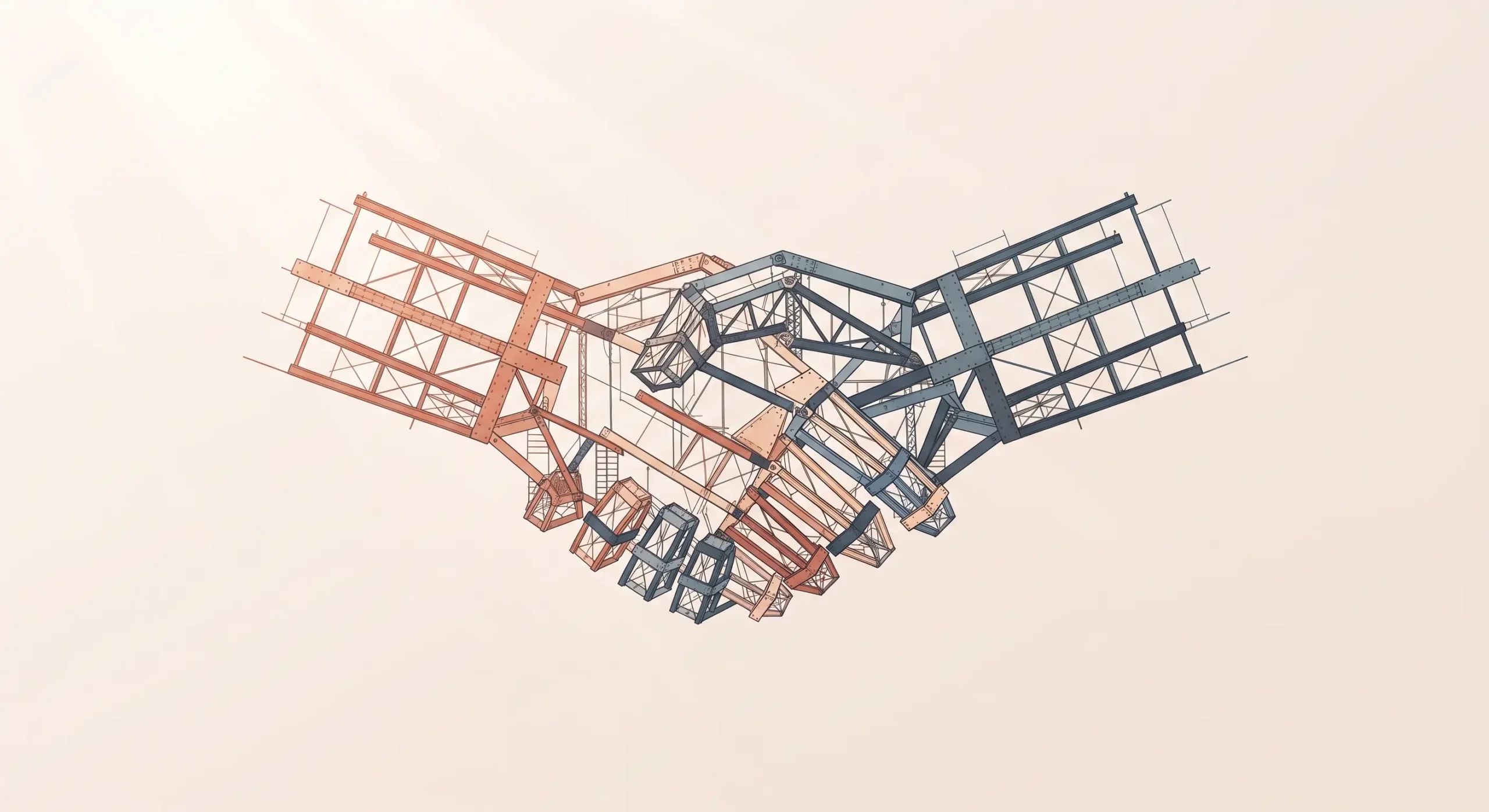
A handshake deal looks like the opposite of structure. No contract, no clauses, no fine print — just two people agreeing to something and meaning it. But that’s a misreading. A handshake deal isn’t an absence of architecture. It’s trust built as architecture, load-bearing in its own way, just invisible to anyone looking for paperwork.
The question isn’t whether handshake deals are reliable. It’s what has to be in place before the handshake for it to hold weight at all.
What Makes a Handshake Deal Hold? (Quick Answer)
A handshake deal holds when trust has already been established through prior behavior, clear mutual understanding, and low ambiguity about what each side owes the other. It fails when any of those three are missing — not because people are dishonest, but because unwritten agreements can’t survive unspoken assumptions. The deal is only as strong as the relationship architecture underneath it.
Trust Is Infrastructure, Not a Feeling
We tend to think of trust as an emotion — something you feel toward a person. But in a handshake deal, trust functions more like infrastructure: it’s what the agreement is built on top of, and like any foundation, it has to be tested before weight is put on it.
This is why handshake deals rarely happen between strangers. They happen between people who’ve already been through smaller exchanges — a favor returned, a deadline honored, a difficult conversation handled with care. Each of those moments is a small reading of the room, a data point about whether this person follows through when no one’s watching. By the time the handshake happens, both sides have already run the trust test — they just didn’t call it that.
Why Ambiguity Is the Real Risk, Not Dishonesty
Most handshake deals that fall apart don’t fail because someone lied. They fail because something was never actually agreed on — it was assumed. One side believed “I’ll help you move” meant a Saturday afternoon; the other believed it meant the whole weekend, including hauling furniture up three flights.
This is where communication etiquette (apply this to any spoken-only agreement) and clarity matter more in handshake deals than in written ones — there’s no clause to point back to when memories diverge. The deal is only as precise as the conversation that created it, which means the words used to strike it carry the entire legal weight a contract would otherwise hold.
The Silence That Seals a Handshake Deal
There’s often a pause after the terms are said out loud and before the hands actually meet — and that pause does real work. It’s the moment both people silently check: do I actually mean this? Silence in conversation frequently carries more information than the words around it, and a handshake rushed through without that beat can feel transactional rather than binding, even if the terms were identical.
Saying No Before the Handshake, Not After
The strength of a handshake deal often depends on what happened before it — specifically, whether either side was willing to say no during negotiation. A person who agrees to everything without pushback hasn’t actually tested the deal; they’ve just avoided conflict. Saying no is a craft, and a handshake that survived an honest “that doesn’t work for me, but this would” is sturdier than one that sailed through on agreeableness alone, because both sides know the terms were actually examined.
Small Talk Isn’t Filler — It’s the Trust Test
The small talk before a handshake deal gets dismissed as warm-up chatter, but it’s rarely wasted time. Small talk functions as an early trust signal — how someone handles an unscripted, low-stakes moment often predicts how they’ll handle the deal itself. People who are careless or dismissive in small talk tend to be careless with unwritten commitments too. The handshake isn’t really the start of the trust-building. It’s the end of it.
When the Deal Moves to Text or a Voice Note
Modern handshake deals rarely stay fully verbal — they often get confirmed afterward over text (“great, talk soon 👍”) or a quick voice note recapping the terms. This follow-up matters more than people think. Without tone of voice or eye contact, emojis start carrying the emotional confirmation that a handshake once carried physically. A voice note sent to recap the deal adds back some of that missing warmth — tone, pacing, hesitation — that a text thread strips away, which is partly why people instinctively reach for a voice note after an important handshake rather than typing out the recap.
What Happens When a Handshake Deal Breaks
When a handshake deal goes wrong, the instinct is to focus on who’s at fault. But the more useful question is structural: which part of the architecture was missing? Was the ambiguity never resolved? Was trust assumed rather than earned? Was the price or scope never actually said out loud?
This is where pricing becomes a quiet trust issue — a huge share of broken handshake deals trace back to money never being stated plainly. “We’ll figure out the number later” sounds generous in the moment and becomes the exact seam the deal splits along later, because money is the one term neither side wants to be the first to pin down.
An honest apology, done right, can sometimes repair a handshake deal that’s cracked but not broken — but the order of the words matters enormously here. “I’m sorry, but I assumed…” reopens the wound instead of closing it.
Handshake Deals vs. Written Contracts
| Handshake Deal | Written Contract |
|---|---|
| Built on prior trust | Built on enforceable terms |
| Fails through ambiguity | Fails through loopholes |
| Repair relies on relationship | Repair relies on legal recourse |
| Speed and flexibility | Precision and protection |
| Works best for low-stakes, known parties | Works best for high-stakes, unknown parties |
| No paper trail | Explicit paper trail |
Neither is inherently better — they’re suited to different stakes. A handshake deal scales with trust already built; a contract substitutes for trust that hasn’t been built yet.
When a Handshake Deal Is the Wrong Choice
Not every agreement should be a handshake, no matter how strong the relationship. High financial stakes, long timelines, or multiple parties all raise the cost of ambiguity to a level a handshake can’t absorb. In those cases, insisting on a written agreement isn’t a lack of trust — it’s recognizing that even the strongest relationship architecture has a load limit.
Frequently Asked Questions
What makes a handshake deal legally or practically binding?
Practically, it’s binding when both parties share a clear, identical understanding of the terms and have a track record of following through. Legally, enforceability varies by jurisdiction and context — verbal agreements can carry legal weight, but proving the exact terms is harder without documentation.
Why do handshake deals fail even between honest people?
Most failures come from unspoken assumptions, not dishonesty. Each side assumes the other understood the same scope, timeline, or price — and only discovers the gap once something goes wrong.
Is a handshake deal the same as “no structure”?
No. A handshake deal replaces written structure with relational structure — prior trust, clear conversation, and mutual accountability do the work a contract would otherwise do.
When should you insist on a written agreement instead?
When the financial stakes are high, the timeline is long, more than two parties are involved, or either side has any doubt about shared understanding of the terms.
Does following up a handshake deal with a text or voice note matter?
Yes. A brief written or voice recap reduces the ambiguity risk that causes most handshake deals to fail, without undermining the trust-based nature of the agreement itself.