Blog and Articles Editing: Subtraction as a Creative Act
Most people think editing means improving what’s there. It doesn’t. Editing means removing what shouldn’t be. A first draft is rarely wrong in what it says — it’s wrong in how much of it is saying nothing at all. The editor’s real job isn’t to add better words. It’s to find the sentence hiding underneath all the other sentences, and delete everything standing in front of it.
This is a harder skill than writing. Writing is generative — you’re building something from nothing. Editing is the opposite instinct: you already have something, and your job is to trust that less of it is more.
What Does “Editing as Subtraction” Mean?
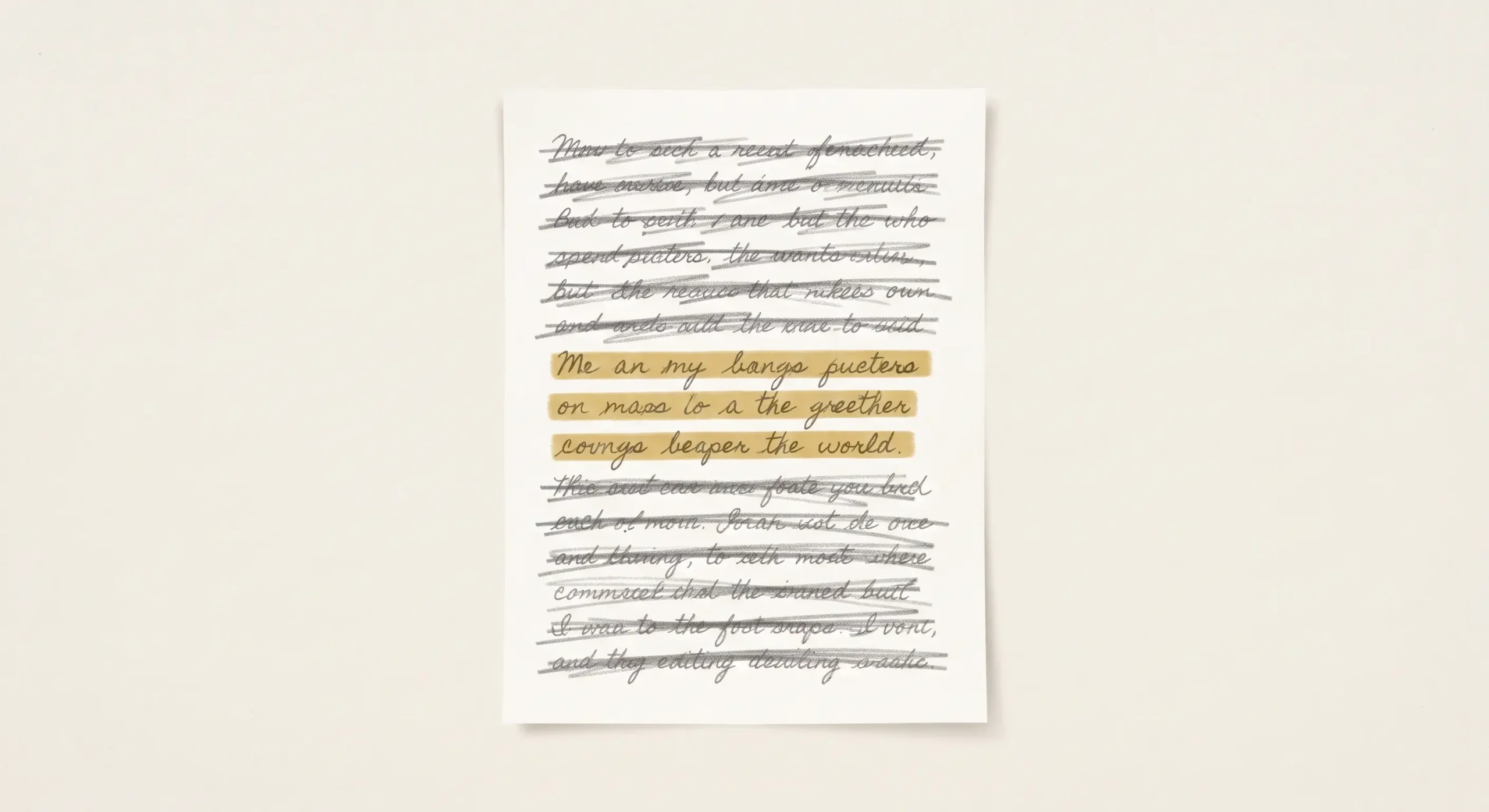
Editing as subtraction means treating every unnecessary word, sentence, or paragraph as active damage to the piece, not neutral filler. Instead of asking “does this add value?”, a subtractive editor asks “does removing this hurt the piece?” — and if the answer is no, it goes. The goal isn’t a shorter article. It’s an article with nothing left to cut.
Why Most First Drafts Are Too Full
A first draft is written in discovery mode — the writer is figuring out what they think while writing it. That means early drafts are full of throat-clearing: context the writer needed to find their point, but the reader doesn’t need to read. The opening three paragraphs of most drafts exist to help the writer arrive at paragraph four. A good edit deletes paragraphs one through three and starts there.
This connects directly to the first sentence of a blog post: if a reader has to wade through a page of setup before the real idea appears, they’ve already left. Subtractive editing isn’t about trimming fat from a good opening — it’s about finding where the actual opening is buried, and cutting everything before it.
The Headline Is the First Casualty
Before touching a single paragraph, a subtractive editor interrogates the headline. Most headlines try to say three things at once: the topic, the angle, and a clever turn of phrase. Usually only one of those is doing real work. A great headline is a promise in six words — which means editing a headline is rarely about making it more clever. It’s about identifying the one true promise and deleting the other two.
Subtraction Is a Form of Pricing
There’s an odd parallel between editing and pricing psychology: both are exercises in removing noise so the one number — or the one sentence — that matters can be seen clearly. A price with too many decimal justifications feels untrustworthy. A paragraph with too many qualifiers feels the same way. In both cases, confidence is communicated by what’s absent, not what’s included.
Why Cutting Feels Like Losing Control
Writers resist cuts because removing a sentence feels like removing effort — the work it took to write it. But a reader never sees your effort. They only see what’s left on the page. This is similar to dignity as a design principle: respecting the reader means not making them wade through your process to find your point. The kindest thing an editor can do is remove everything the reader doesn’t need to carry.
Reading the Draft Like You’d Read a Room
Good editing requires reading the room — except the room is the piece itself. Where does attention drop? Where does a reader skim instead of read? A subtractive editor reads a draft the way they’d read tension in a meeting: watching for the exact paragraph where interest quietly leaves, then cutting from that point rather than polishing around it.
Every Unnecessary Caveat Is a “But” in Disguise
Just as an apology collapses the moment it includes an unnecessary “but”, an article collapses the moment it hedges a strong claim with three qualifiers. “This approach often works, though results vary, and of course every situation is different” says nothing. Subtraction means picking the one true claim and removing the hedges protecting the writer instead of informing the reader.
Structure Edits Like a Pitch Deck
A persuasive article follows the same discipline as a well-built pitch deck: every section exists to resolve the doubt raised by the section before it. If a paragraph doesn’t move the argument forward, it’s not neutral — it’s a slide that shouldn’t be in the deck. Editing by subtraction means asking of every paragraph what a founder asks of every slide: does this belong here, in this order, or at all?
Trust Is Built the Same Way You’d Build It With a Handshake
A tight, well-edited piece earns reader trust the way a handshake deal earns trust — through restraint, not persuasion effort. Over-explaining a point signals the writer doesn’t trust the reader to get it. A clean, confident sentence says the opposite: I trust you to understand this without me circling it three times.
The Business Card Principle: Say Less, Signal More
A business card compresses an entire brand into a palm-sized object — no paragraph of explanation, just the essential signal. Good editing applies the same compression to writing: the goal isn’t to explain everything about a topic, it’s to leave only what the reader actually needs to walk away with. Everything else is the editorial equivalent of cramming a company history onto a 3.5×2 inch card.
Negotiating With Your Own Draft
Cutting a paragraph you like requires the same skill as any negotiation: separating what you want from what the piece actually needs. A writer negotiating with their own draft has to read the room of the argument itself before reaching for the delete key — not every sentence is a loss, and not every cut is a sacrifice. Some cuts are simply the piece telling you what it never needed.
A Practical Subtraction Checklist
- Cut the first three paragraphs and see if the piece still works. Usually, it works better.
- Remove every sentence that restates a point already made. Readers remember once, not three times.
- Delete qualifiers that protect you, not the reader — “sort of,” “in some ways,” “arguably.”
- Cut any paragraph that could be summarized by the one before it.
- Re-read the headline last. If the piece changed during editing, the headline’s promise needs to match what’s actually left.
Common Editing Mistakes (And the Fix)
| Mistake | Why It Fails | Fix |
|---|---|---|
| Adding transition sentences to “smooth” cuts | Transitions often exist to justify sentences that shouldn’t be there | Cut the sentence needing justification, not add a bridge to it |
| Keeping a strong sentence in a weak paragraph | The sentence gets buried by what surrounds it | Move the sentence, delete the rest |
| Editing for length instead of clarity | Produces shorter drafts that are still unclear | Cut based on “does this help the reader,” not word count |
| Polishing the opening instead of questioning it | Assumes the problem is word choice, not placement | Ask if the real opening is actually three paragraphs later |
| Treating every cut as a loss | Makes editors precious about weak material | Remember: nothing is lost if the reader never needed it |
Frequently Asked Questions
What does “editing as subtraction” mean?
It’s an editing philosophy that treats removal, not addition, as the primary tool for improving a piece — cutting anything that doesn’t actively help the reader, rather than polishing what’s already there.
Why is subtractive editing harder than writing?
Writing is generative and forgiving of excess; editing requires deciding what to sacrifice, which feels like a loss even when the piece improves.
Should I cut my opening paragraphs even if I like them?
Often, yes — opening paragraphs are usually where the writer is still finding the point, not where the reader needs to start.
How do I know what to cut from a draft?
Ask whether removing a sentence hurts the piece. If the answer is no, it’s not adding value — it’s just occupying space.
Does shorter always mean better edited?
Not necessarily. The goal isn’t brevity for its own sake — it’s removing everything that isn’t earning its place, even if the result is still reasonably long.