The Art of the Onboarding Flow: A First Date With Your Product
Every relationship has a first date.
Before commitment, before habit, before loyalty — there is a single, fragile moment where two strangers decide whether there will be a second meeting.
Software has the same moment.
It’s called onboarding, and it is, without exaggeration, the first date your product will ever have with a user. Everything that happens afterward — retention, trust, advocacy, revenue — is downstream of how that first date goes.
Most products treat onboarding as a formality. A tour. A checklist. A tooltip parade. But the best products understand something subtler: onboarding isn’t a feature you build once. It’s a conversation you design on purpose.
What Is an Onboarding Flow?
An onboarding flow is the sequence of screens, prompts, and interactions that guides a new user from first contact with a product to their first meaningful moment of value.
That “first meaningful moment of value” has a name in product circles: the aha moment — the point where a user stops evaluating your product and starts using it. Good onboarding isn’t about showing off every feature. It’s about getting the user to that aha moment as fast, and as painlessly, as possible.
In simple terms: onboarding is not a tutorial. It’s a trust-building exercise disguised as a tutorial.
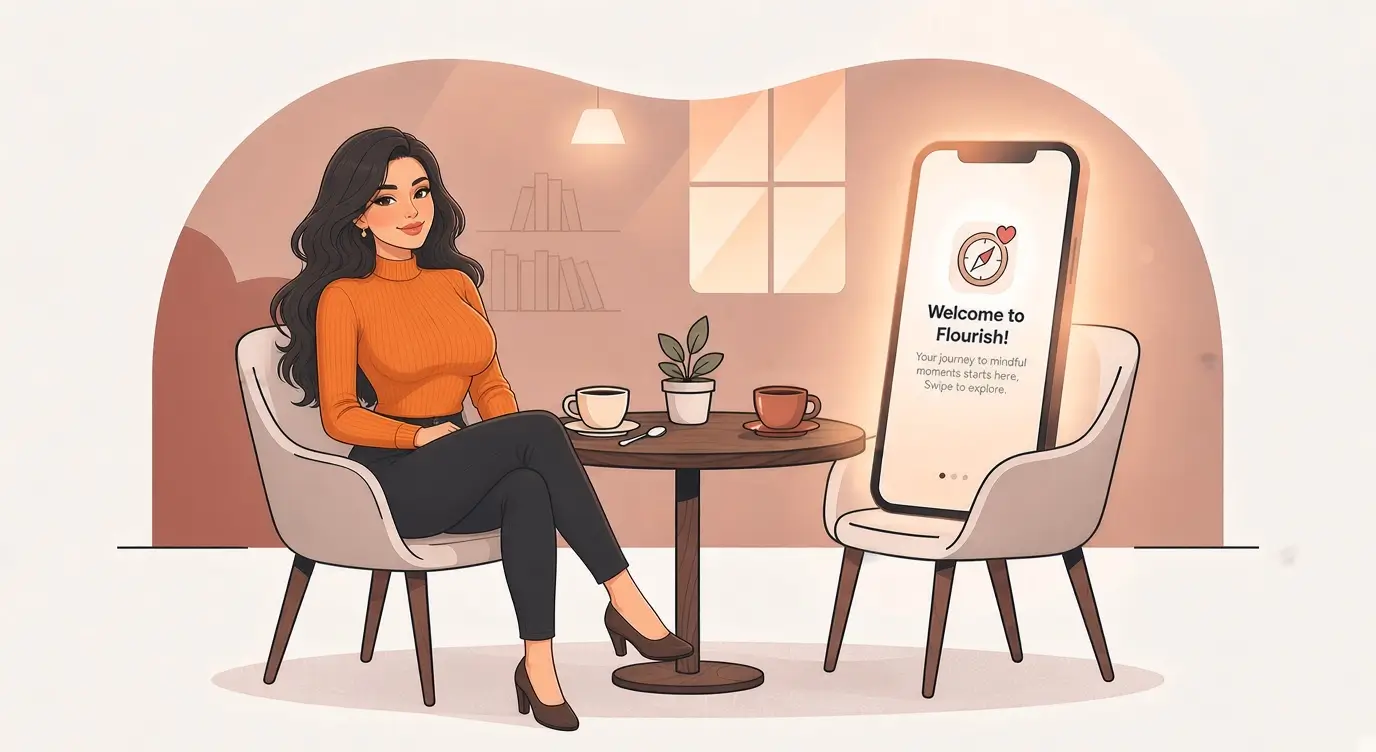
Why Onboarding Deserves the “First Date” Metaphor
Think about an actual first date. Nobody wants:
- A stranger who talks about themselves for twenty minutes straight
- A checklist of questions that feels like an interrogation
- Someone who assumes deep familiarity you don’t have yet
- A person who oversells themselves in the first five minutes
And yet that’s exactly what bad onboarding does. It monologues (“Welcome to our platform! Here are 14 features!”). It interrogates (asking for a credit card, a company name, and three preferences before showing any value). It assumes (“Just connect your API key to get started”). It oversells (modal after modal of “Did you know you can also…”).
A great first date, by contrast, is paced. It listens before it talks. It reveals personality gradually. It creates just enough curiosity to earn a second meeting — without demanding commitment before trust has been built.
That’s the entire philosophy of great onboarding, translated.
The Four Phases of a Great Onboarding Flow
1. The First Impression (Before They’ve Done Anything)
This happens before the user taps a single button — it’s the visual tone, the copy, the loading state, the first screen they see. It’s the equivalent of what someone wears to a first date. It doesn’t guarantee anything, but it sets expectations instantly.
This is where visual identity does real work. A dashboard that opens into a jarring, over-bright interface at 11pm sends a different signal than one that respects context — which is part of why thoughtful dark mode design has become an onboarding consideration, not just a settings toggle. The first thing a user sees should feel like it was designed for them, not just designed.
2. The Reveal (Showing, Not Telling)
The biggest onboarding mistake is explaining the product instead of letting the user experience it. Nobody on a first date wants a resume read aloud to them. They want to notice things themselves.
Good onboarding creates small, safe moments of discovery:
- A pre-filled example so the user sees output before creating input
- An interactive first action instead of a passive slideshow
- Real data (or a great sample) instead of empty states with instructions
This is the same principle behind good app design generally — function and feeling have to move together. An onboarding flow that functions perfectly but feels cold will still lose the user.
3. The Ask (Earning the Right to Request Something)
Every onboarding flow eventually needs something from the user — an account, a permission, a piece of data. The art is in the sequencing. Ask before value is delivered, and it feels transactional. Ask after value is delivered, and it feels earned.
This is identical to dating etiquette: you don’t ask someone to meet your parents on the first date. You earn escalating trust in proportion to demonstrated value.
4. The Follow-Up (What Happens After They Leave)
A first date doesn’t end when dinner ends — it ends with whether there’s a text the next morning. Onboarding doesn’t end when the tutorial closes. It continues through the first few days via emails, in-app nudges, and notifications.
This is where restraint matters most. The fastest way to ruin a promising new relationship with a user is to interrupt them constantly in week one. Every notification is a request for attention, and that request should be treated with the same care outlined in the etiquette of interrupting someone — timed, relevant, and never desperate.
Common Onboarding Mistakes (And Why They Feel Like Bad Dates)
| Mistake | What It Feels Like on a Date |
|---|---|
| Asking for too much info upfront | Being asked your salary on date one |
| Long feature tours with no interactivity | Someone reading their résumé aloud |
| Empty states with no guidance | Awkward silence with no conversation starter |
| Forcing account creation before value | Being asked to define the relationship immediately |
| Generic, one-size-fits-all flows | Feeling like “one of many” |
| No path back when something goes wrong | Being ghosted mid-conversation |
That last point matters more than most teams realize. Onboarding flows are rarely linear in practice — users tap the wrong thing, hit dead links, or land somewhere the product never designed for. How a product handles that unplanned wrong turn says as much about it as the polished happy path does. It’s the same principle behind designing a good 404 page: the moments a product handles getting lost well are often what earns long-term trust, not just the moments it goes right.
Personalization: Reading the Room
The best first dates adapt in real time — to what the other person says, how they react, what they seem to care about. Static onboarding flows can’t do this. Adaptive ones can.
Modern onboarding increasingly branches based on:
- Stated intent (“What are you trying to do today?”)
- Role or persona (a marketer’s first five minutes should differ from a developer’s)
- Behavioral signals (skipping a step, hesitating, re-reading a screen)
This is product design responding to a person in the moment, rather than performing a script regardless of audience — the difference between a conversation and a monologue.
Testing Your Onboarding Flow Like a Detective, Not a Cheerleader
It’s tempting to test onboarding by asking “does it work?” That’s the wrong question. The right question is closer to what a good debugging process asks: where exactly does trust break down, and why?
Great teams treat onboarding testing the same way they’d approach debugging as detective work — following the evidence (drop-off points, session recordings, time-on-screen) rather than assuming they already know where users struggle. The instinct to defend a flow you designed is exactly the instinct that needs to be set aside to actually fix it.
Signals worth investigating:
- Time-to-value — how long until the first meaningful action?
- Drop-off points — where do users abandon the flow?
- Skip rate — which steps do users routinely bypass?
- Return rate — do users come back after session one?
- Support tickets during week one — what confuses people enough to ask for help?
The Documentation Behind the Experience
Nobody sees an onboarding flow’s internal logic — the conditionals, the event triggers, the fallback states. But someone has to maintain it, and six months from now, someone (possibly you) will need to understand why a particular step exists.
This is where discipline pays off invisibly. Just as a clear commit message explains the why behind a change rather than just the what, well-documented onboarding logic explains why a step was added, what problem it solved, and what was tried before it. Good onboarding isn’t just designed once — it’s iterated on for years, and future decisions are only as good as the history left behind them.
How to Design an Onboarding Flow: A Practical Framework
- Define the aha moment first. Before designing any screen, identify the single moment that makes a user say “oh, that’s what this is for.” Everything in the flow should point toward it as directly as possible.
- Cut every step that doesn’t serve the aha moment. If a step doesn’t accelerate the user toward value, it’s friction, not onboarding.
- Front-load value, back-load commitment. Show something real before asking for something real.
- Design for the wrong turn, not just the happy path. Assume users will tap the wrong thing — plan a graceful recovery.
- Personalize where it matters, generalize where it doesn’t. Branch on real signals of intent, not vanity segmentation.
- Follow up like a considerate person, not a marketing calendar. Every nudge after signup should feel earned, timed, and relevant.
- Instrument everything. You cannot improve what you cannot see — track drop-off, hesitation, and abandonment at every step.
- Revisit it quarterly. Onboarding rots. What worked for last year’s users may not fit this year’s product or audience.
Frequently Asked Questions About Onboarding Flows
What is the goal of an onboarding flow?
The goal is to get a new user to their first meaningful moment of value — the “aha moment” — as quickly and painlessly as possible, while building enough trust that they choose to come back.
What’s the difference between onboarding and a product tour?
A product tour explains features. Onboarding delivers an experience. A tour tells; onboarding shows. Many products confuse the two, which is why so much onboarding feels like being talked at rather than welcomed in.
How long should an onboarding flow be?
As short as it can be while still reaching the aha moment. There’s no universal number of steps — the right length is determined by how fast real value can be demonstrated, not by a fixed screen count.
Should onboarding ask for information upfront?
Only what’s essential to deliver the very next step. Anything else should be requested later, after the user has experienced value and has more reason to trust the exchange.
Why do users abandon onboarding flows?
The most common reasons are asking for too much too soon, unclear value before commitment is requested, generic flows that ignore user intent, and poor recovery when a user takes an unexpected path.
How do you measure if onboarding is working?
Track time-to-value, drop-off rate at each step, feature adoption in the following days, and return rate after the first session — not just completion rate of the flow itself.
The Real Art of Onboarding
A first date isn’t judged by how much information was exchanged. It’s judged by how it felt, and whether it created enough curiosity to want a second one.
Onboarding works the same way. It isn’t measured by how many features got explained. It’s measured by whether a stranger left the interaction thinking, I understand what this is for, and I want to come back.
That’s the entire craft, distilled: read the room, earn the trust, and never propose on the first date.