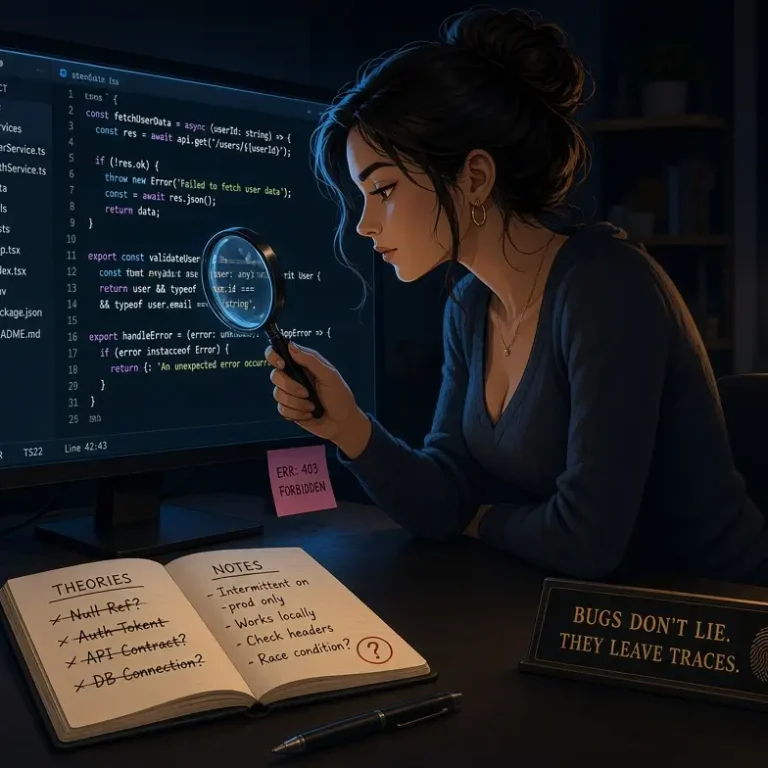
The Art of the Commit Message: Writing for Your Future Self
Quick Answer
A good commit message explains why a change was made, not just what changed — written clearly enough that a stranger (or you, in six months) can understand the reasoning without re-reading the diff. The best commit messages follow a short, imperative summary line under 50 characters, a blank line, and a body that explains context, trade-offs, and consequences.
That one paragraph answers the question. Everything below explains why it’s true, and how to actually do it.
Commit Messages Are a Design Problem, Not a Formatting Rule
Most developers treat commit messages as paperwork — a box to fill before git push. But a commit message is a small piece of interface design. It has an audience (your team, your future self), a context (a moment of confusion, months later), and a job to do (restore understanding fast).
This isn’t a stretch. It’s the same instinct that shapes every other quiet, easy-to-ignore detail in software. A 404 page is technically “just an error,” but a thoughtful one turns frustration into trust. A loading screen is technically “just a delay,” but a well-designed one makes waiting feel intentional instead of broken. A commit message is the same category of thing: a small, unglamorous surface that either respects the person reading it — or wastes their time.
At Picasso Art, the recurring theme is that craft lives in the details nobody’s forced to notice. Commit messages belong on that list.

Why Commit Messages Matter More Than They Seem To
You Will Forget Why You Wrote That Code
The core problem commit messages solve is memory decay. You understand your code perfectly today. In three months, staring at a strange if statement with no explanation, you won’t remember whether it was a deliberate fix, a workaround, or a mistake you meant to clean up later.
A commit message is a message in a bottle to your future self. It’s cheaper to write two sentences now than to spend twenty minutes later reverse-engineering your own reasoning.
Code Review and Debugging Depend on History
When something breaks in production, git blame and git log are often the fastest path to understanding why a line exists. A commit history full of messages like "fix", "update", and "wip" turns a five-minute investigation into a forensic exercise. A history of clear, specific messages turns it back into five minutes.
It’s a Form of Communication Etiquette
Just as notification etiquette is about respecting someone’s attention before you interrupt it, a commit message is about respecting someone’s time before you make them dig through a diff to understand your intent. Both are small acts of consideration baked into a system.
What Makes a Commit Message Good
The Anatomy of a Great Commit
Fix race condition in payment retry logic

The retry handler was firing before the previous request's
cleanup completed, occasionally double-charging users on
flaky networks. Added a mutex lock around the retry queue.

Fixes #482
Three parts, each with a job:
- Summary line (imperative mood, ~50 characters) — “Fix,” not “Fixed” or “Fixes.” It reads like an instruction: “If applied, this commit will…”
- Blank line — separates summary from body so tools (like
git log --oneline) can parse it cleanly. - Body — explains why, not just what. The diff already shows what changed; the message should explain the reasoning the diff can’t show.
The “Why,” Not the “What”
This is the single most common mistake. A message like:
“Changed timeout value from 3000 to 8000”
…tells you nothing the diff didn’t already show. Compare it to:
“Increase API timeout to 8s — mobile users on 3G were hitting timeouts during checkout, causing abandoned carts (see analytics ticket #219)”
The second version is a commit message doing its actual job: preserving context that would otherwise be lost the moment the ticket is closed.
Common Commit Message Mistakes
- Vague summaries — “fix bug,” “update stuff,” “changes.” These fail the six-months-later test immediately.
- Commits that do five things at once — makes reverting or reviewing painful; each commit should represent one logical change.
- No context for non-obvious decisions — if a reviewer would reasonably ask “wait, why?”, answer it in the message before they ask.
- Inconsistent tense and style across a team — small, but it adds friction to scanning history quickly, much like inconsistent dark mode contrast makes an interface harder to read even when every individual color is “technically” fine.
- Treating messages as an afterthought — written in ten seconds right before pushing, instead of as part of the actual work of finishing a change.
A Practical Framework for Writing Commit Messages
- Write the summary line first, in imperative mood. (“Add,” “Fix,” “Remove,” not “Added,” “Fixing.”)
- Ask: would this make sense to someone with zero context? If not, add a body.
- Explain trade-offs, not just outcomes. If you chose a quick fix over a proper one, say so — it saves the next person from re-litigating the decision.
- Reference tickets or issues where relevant, so history connects to the “why” that lives elsewhere.
- Keep one commit = one idea. If your message needs the word “and” three times, it’s probably two commits.
Commit Messages Are Part of the Product, Even If Users Never See Them
There’s a broader idea running through good software craft: the parts nobody’s forced to polish are often what separate a good product from a great one. That’s true of an app’s interaction design, where function and feeling have to work together — and it’s just as true of the invisible layer underneath the app: the codebase itself, and the trail of decisions that built it.
A commit history is, in a sense, a private product with an audience of one — your team, and future-you. Writing it with the same care you’d bring to a user-facing screen isn’t overkill. It’s consistency.
Frequently Asked Questions
What is a good commit message format?
A short imperative summary line (ideally under 50 characters), a blank line, then a body explaining the reasoning behind the change — not just what code was altered.
Should commit messages be written in past or present tense?
Present, imperative mood — “Add,” “Fix,” “Remove” — as if completing the sentence “If applied, this commit will…”
How long should a commit message be?
The summary line should be short (under ~50 characters). The body has no strict limit — write enough to explain context a diff can’t show, but stop once the reasoning is clear.
Why do commit messages matter if no user ever sees them?
Because your team and your future self are the users. Commit messages reduce debugging time, speed up code review, and preserve decisions that would otherwise be lost when a ticket closes.
What’s the biggest mistake developers make with commit messages?
Describing what changed instead of why. The diff already shows what changed — a good message adds the missing context.
Key Takeaway
A commit message is a tiny act of design: it has an audience, a moment of use, and a job to do. Written well, it turns a confusing six-months-later mystery into a five-second answer. Written poorly, it’s one more small tax on everyone who touches the code after you — including yourself.
Write for your future self. They’re reading this history before they remember why any of it happened.